⚡ Quick Answer
✅ Do
- Check the facility's policy before visiting
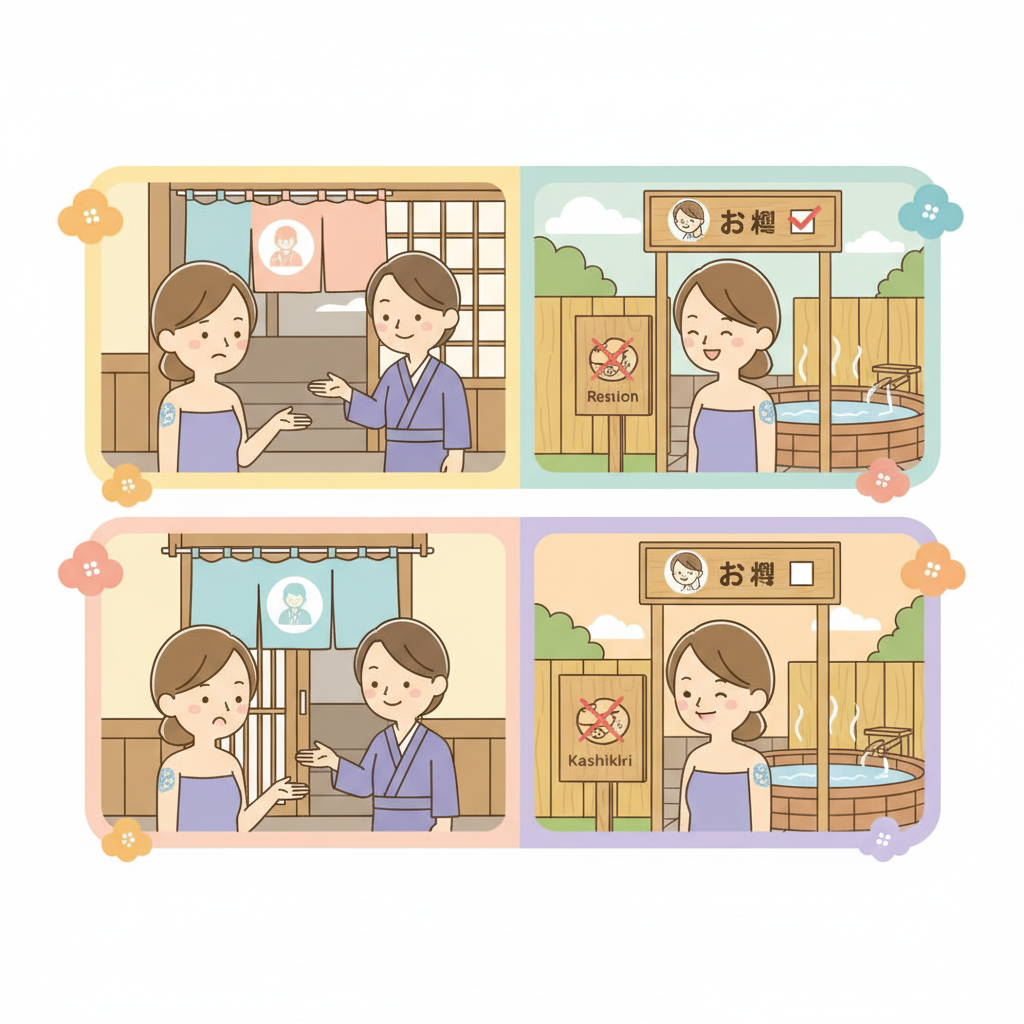
- Ask about private rental baths (kashikiri)
- Book tattoo-friendly facilities in advance
- Use small waterproof covers if the facility allows
❌ Avoid
- Entering a public bath without checking first
- Assuming all onsen follow the same rules
- Hiding tattoos without permission
- Getting frustrated — private options do exist
The Short Answer: It Depends
Many traditional Japanese onsen and public bathhouses (sentō) still prohibit tattoos in their shared baths. This policy dates back decades and is tied to historical associations between tattoos and organized crime in Japan.
However, things are changing. Many facilities — especially those catering to international visitors — now offer private rental baths, tattoo-friendly hours, or explicit welcome policies. With a little research, tattooed travelers can absolutely enjoy the onsen experience.
Why Do Onsen Prohibit Tattoos?
Japan's traditional tattoo taboo is rooted in cultural history, not aesthetics. For much of modern Japanese history, tattoos were associated with yakuza (organized crime) and people living outside mainstream society. Many onsen operators built their "no tattoo" rules to maintain a family-friendly, safe atmosphere for all guests.
Today, the younger generation's attitude toward tattoos is shifting, and the increasing number of international visitors with tattoos has pushed many facilities to reconsider their policies. But change is gradual — you cannot assume a traditional facility has changed its rules.
Types of Onsen and Their Policies
| Facility Type | Tattoo Policy | Private Bath? |
|---|---|---|
| Traditional public onsen (sentō) | Often prohibited | Rarely available |
| Hotel / ryokan onsen | Varies — check ahead | Often available |
| Tattoo-friendly onsen | Welcome | Sometimes available |
| Private rental bath (kashikiri) | Usually OK | By definition, yes |
| Private room with bath (heya-buro) | Usually OK | Yes |
What Is a Kashikiri Bath?
A kashikiri (貸切風呂) is a private rental onsen bath reserved exclusively for your group — typically for 45–60 minutes. You and your travel companions bathe alone in a fully equipped private room with an onsen-fed tub.
Many ryokan include kashikiri as a standard option (sometimes included in the room rate, sometimes at an extra cost of ¥1,000–¥3,000). This is one of the best ways for tattooed travelers to enjoy the full onsen experience without any restrictions.
Looking for tattoo-friendly onsen or private baths?
Book a ryokan with a private open-air bath (rotenburo) for an unforgettable onsen experience with no restrictions.
Browse Ryokan with Private Baths →Tattoo Cover Patches: Are They Allowed?
Some facilities allow small tattoos to be covered with waterproof skin-colored patches. These are sold at pharmacies in Japan. Whether this option is permitted varies entirely by facility — some explicitly allow it, others do not.
If you want to try this approach, contact the facility beforehand and confirm their policy clearly. Do not assume that covering a tattoo automatically grants entry.
How to Find Tattoo-Friendly Onsen
- Search "tattoo friendly onsen Japan" or "タトゥー OK 温泉" on booking sites
- Filter results on Booking.com, Jalan, and Rakuten Travel for ryokan with private baths
- Ask at tourist information offices (観光案内所) in each city
- Some areas — like Beppu, Kinosaki, and parts of Hokkaido — have a higher concentration of tattoo-friendly facilities